Shape Simplification
By 1920, Curatella Manes had completed the scholarship the Argentine Government had granted him. On his third trip to Europe he settled in Paris where he found the support and friendship of his prominent teacher, Bourdelle. He also enjoyed the friendship of Juan Gris, Fernand Léger, André Lhote, Laurence, Reverdy, Constantin Brancusi, and Le Corbusier among others.
Having met Juan Gris was decisive for Curatella Manes. The folded and articulated cardboard figurines Juan Gris made for Sergio Diaghilew ' s Russian ballets encouraged Curatella Manes to freely express his sculptor's vision. That was how El Guitarrista [The Guitarist] came to life, the first work of a very productive period. He distanced himself from cubism and from the baroque, as his main interest now was how to simplify shapes by geometrizing them.
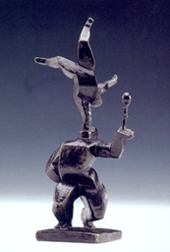
With a new compression of planes and light, and by applying the same elegance portrayed in El Guitarrista, he created El Acordeonista [The Accordionist], El Hombre del Contrabajo [The Man of the Double Bass], and some female nudes, such as Mulata and Ninfa Acostada [Lying nymph]. Later, Los Acróbatas [The Acrobats], which was inspired by a circus show. This opened up new horizons on the possibility of lightening the matter, airing the volumes, and insinuating movement by maintaining only the outline.
Dynamics and the Conquest of Space
My desire is to give sculpture a sense of life, movement, strength, or even better, suggest it through the effective means of sculpture. Mere ridicule does not tempt me; I want to see planes, roundness, and emptiness. The art subject should prevail over the anecdote motive. By saying this, I do not mean that art should be reduced to mere geometric problems; overall there is the magic of light.
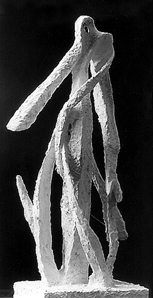
These were Curatella Manes statements at the time, and they reflected his ongoing quest. His modelling reached a new lyric impulse, of planes independent from volume, fleshless forms that led to movement and strengthened the victory of light. He created a number of open sculptures, structures of thick, intertwined filaments; aerial shapes, in spite of the coarse material used in their creation, he found the balance of the mass, correspondence between volumes, huge rhythms and the distribution of light in order to accomplish his ideal. From that time are Ícaro [Icarus] , Rugby [Rugby], La Danza [The Dance], and La Santa [The Saint].
Revisit
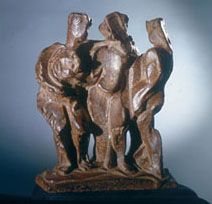
In August 1926 he started working for the Argentine Embassy in Paris as Foreign Affairs Officer. The period of adjustment was rather difficult and for over two years he would not go to his studio. After resuming his work as a sculptor, he created Las Tres Gracias [The Three Graces]. After a long period away from sculpting Las Tres Gracias was like a test. This is why it had no connection to his previous work. He revisited heavy volume, blurring the shapes, and barely suggesting a rhythm. His intention was now to show rhythm through the use of volume. His figures took on relaxed postures, and despite the absence of faces they projected naivety.
Even though he had little time to devote to his work, just weekends and holidays, this period was very prolific. Some of his pieces from this period are: Idilio Criollo [Creole idyll], Maternidad [Maternity], El Gaucho y su Caballo [The Gaucho and his Horse], Cabeza del Profeta [The Prophet's Head], Dan, Los Amantes [The Lovers], and the series Los Torsos [The torsos]. The expressiveness achieved during the period was perfected in two great reliefs ordered for the 1937 Paris Exhibition : Los Dos Hemisferios [The Two Hemispheres] and La Tierra Argentina [Argentine Land].
Mother Structure
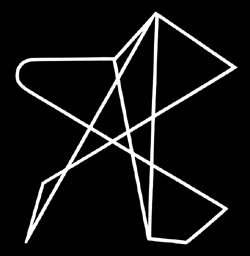
During World War II, suffering the shortcomings of the times, and without a studio or supplies, he devoted himself to drawing. He also worked with clay, metal, and made cardboard mockups. This substantial and unstable use of the shapes led him to what he would call La Estructura Madre [Mother Structure]. He immediately gave it great relevance, considering it the synopsis of everything required in a sculpture. It became the archetype on which he based seven other sculptures. To express what he intended, he used different materials for each figure.
El Pájaro [The Bird] with full planes was cast in bronze. In Falena, he highlighted the transparencies of the planes by using acrylic. In Tango, both planes of the structure were overlapped. In Proyección 7 [Projection 7] he highlighted the outline of the structure by merging the two planes. The golden bronze gave life to the piece. Proyeccion 8 [Projection 8], also praised the outline, but with volume over the planes. In Construcción Espacial [Space Construction], the metal plate allowed development of deep movements over the structure shape. Dos Formas en Una [Two Shapes in One], provided a more open interpretation, both planes merged and connected through a metal plate.